
Nail Size Chart
Why is a 16d nail 3½ inches long? The “d” stands for penny, an old English measure, and it still names nail sizes in the United States. Use the chart to convert penny sizes to inches and millimetres, check gauge and roughly how many nails come in a pound, and let the calculator suggest a nail length for the material you are fastening.
- Free to use
- No sign-up
- Runs in your browser
Quick answer
Common nail sizes are named by penny size, written with “d.” For the searched sizes: a 3d nail is 1¼ in (32 mm), a 10d nail is 3 in (76 mm), and a 60d nail is 6 in (152 mm). Gauge and nails per pound are typical for common nails and can vary by nail type.
Nail size calculator
Nail & Fastener Reference Pack
Printable nail penny size chart (inches and mm), a fastener selection guide, a framing nailing checklist and an Excel fastener estimator.
- Penny size chart (PDF/XLSX)
- Fastener guide (PDF)
- Nailing checklist (PDF, DOCX)
- Estimator (XLSX)
Formats: PDF, XLSX, DOCX. Instant download after payment (link valid 72 hours, up to 5 downloads). AI-assisted: the templates were drafted with AI help and reviewed and laid out before publishing.
$5.00 USD, one-time 4 files · about $1.25 each
- Instant download
- 7-day refund
- Secure checkout by Stripe
7-day money-back guarantee. Full refund within 7 days of purchase, even after you download.
Free sample: Fastener Estimator (PDF, 94 KB)
Full refund within 7 days — see the refund policy and license.
Free printables
Single sheets you can print right now, no sign-up. The full pack adds every sheet in one download plus the editable files.
 Printable Nail Fastener Estimator
Common Nail Sizes Chart
These are typical reference sizes for bright common nails; box, sinker, galvanized, and coated nails may differ.
| Penny | Length | Metric | Gauge | Approx./lb |
|---|---|---|---|---|
| 3d | 1¼ in | 32 mm | 14 | ~540 |
| 4d | 1½ in | 38 mm | 12½ | ~290 |
| 6d | 2 in | 51 mm | 11½ | ~165 |
| 8d | 2½ in | 64 mm | 10¼ | ~100 |
| 10d | 3 in | 76 mm | 9 | ~65 |
| 16d | 3½ in | 89 mm | 8 | ~45 |
| 20d | 4 in | 102 mm | 6 | ~30 |
| 60d | 6 in | 152 mm | 2 | ~10 |
Nail penny size chart
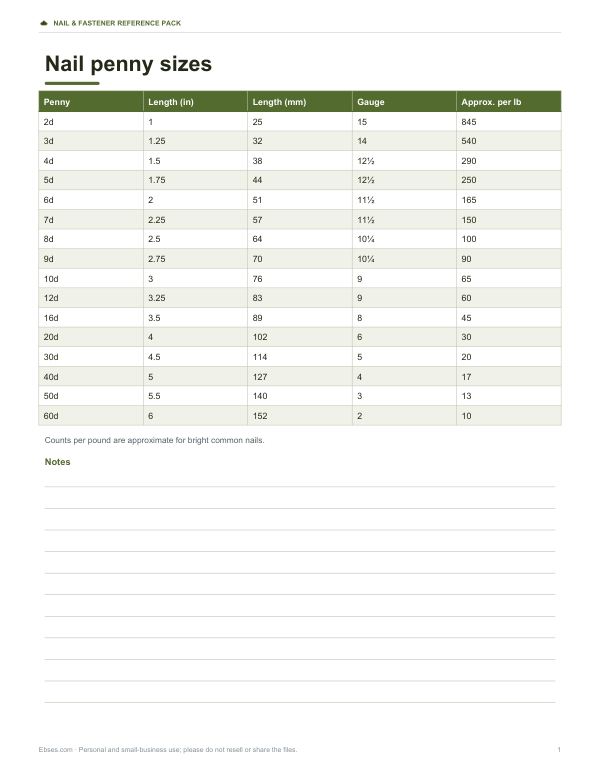
| Penny | Length (in) | Length (mm) | Gauge (common) | Approx. per lb |
|---|---|---|---|---|
| 2d | 1 in | 25 | 15 | ~845 |
| 3d | 1 ¼ in | 32 | 14 | ~540 |
| 4d | 1 ½ in | 38 | 12½ | ~290 |
| 5d | 1 ¾ in | 44 | 12½ | ~250 |
| 6d | 2 in | 51 | 11½ | ~165 |
| 7d | 2 ¼ in | 57 | 11½ | ~150 |
| 8d | 2 ½ in | 64 | 10¼ | ~100 |
| 9d | 2 ¾ in | 70 | 10¼ | ~90 |
| 10d | 3 in | 76 | 9 | ~65 |
| 12d | 3 ¼ in | 83 | 9 | ~60 |
| 16d | 3 ½ in | 89 | 8 | ~45 |
| 20d | 4 in | 102 | 6 | ~30 |
| 30d | 4 ½ in | 114 | 5 | ~20 |
| 40d | 5 in | 127 | 4 | ~17 |
| 50d | 5 ½ in | 140 | 3 | ~13 |
| 60d | 6 in | 152 | 2 | ~10 |
From 2d to 10d, each penny step adds ¼ inch: length (in) = penny ÷ 4 + ½. Above 10d the steps are larger. Counts per pound are approximate for bright common nails; box nails, sinkers, coated and galvanized nails have different counts.
Why nails are sized in “pennies”
The penny system comes from England, where nails were once sold by the hundred and priced in pennies — a hundred 10-penny nails cost ten pence. The abbreviation “d” comes from denarius, the Roman coin that gave its initial to the old British penny. The prices disappeared long ago, but the names stuck, and US hardware stores still sell 8d, 10d and 16d nails. Outside the US, nails are usually labelled by length and diameter in millimetres.
Choosing the right nail length
- Measure the thickness of the piece you are nailing through.
- Multiply by about three: a ¾-inch board needs a nail around 2¼ inches (7d).
- Round to the nearest common size; go slightly shorter if the nail would come through the back.
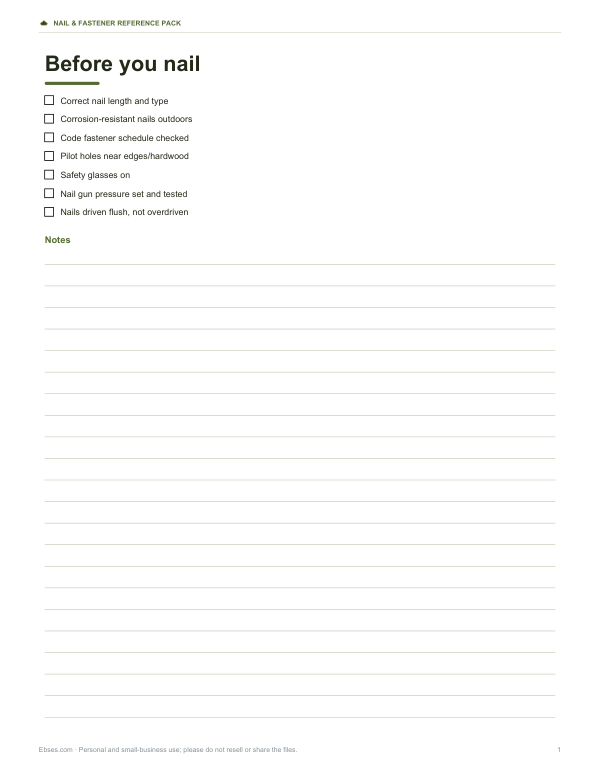
- For framing, follow the fastener schedule in your building code, which specifies nail sizes and spacing for each connection.
- Choose thicker gauges for strength and thinner ones to avoid splitting delicate or hard woods.
Common nail types
| Type | Look | Used for |
|---|---|---|
| Common | Thick shank, flat head | Framing and general construction |
| Box | Thinner than common | Lighter work; less splitting |
| Sinker | Coated, thinner, textured head | Framing with nail guns or by hand |
| Finish | Small head, set below surface | Trim and mouldings |
| Brad | Very thin, small head | Small trim, crafts |
| Roofing | Short, large head, galvanised | Asphalt shingles, felt |
| Ring-shank | Ridges on shank | Subfloors, decking — high holding power |
| Masonry | Hardened, fluted | Concrete and brick |
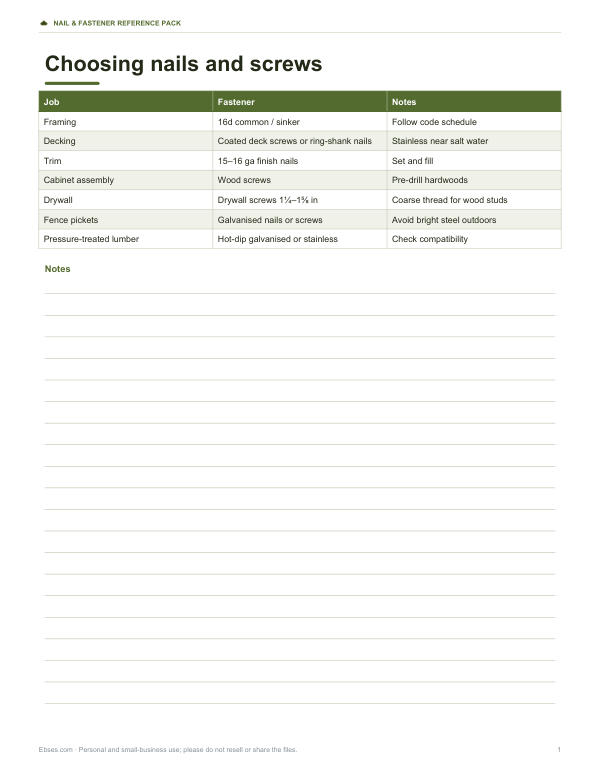
For outdoor work and pressure-treated lumber, use hot-dip galvanised or stainless steel nails to prevent corrosion.
Common framing nail sizes
| Job | Typical nail |
|---|---|
| Framing studs and plates | 16d common or sinker |
| Toenailing studs | 8d or 10d |
| Sheathing and subfloor | 8d common or ring-shank |
| Trim and baseboard | 6d–8d finish |
| Shingles | 1¼–1½ in roofing nails |
| Siding | Galvanised siding nails, length per manufacturer |
Always check local codes and manufacturer instructions; engineered products and structural connections have specific fastener requirements.
Worked example
Nailing ¾-inch pine boards to a frame: 3 × 0.75 = 2.25 inches, so the calculator suggests a 7d nail (2¼ in), with 1½ inches going into the frame. For 200 nails at about 150 per pound, buy roughly 1.3 lb. If the boards are close to the edge or split easily, choose a thinner box nail or pre-drill.
Press-on nail sizes
Press-on (false) nails use a different kind of size chart: each nail in a set is numbered, usually from 0 (widest, for thumbs) to 9 or 10 (narrowest, for little fingers). The width for each number varies between brands. To find your sizes, measure the widest part of each natural nail in millimetres with a flexible tape or strip of tape marked with a pen, then match each finger to the brand’s own chart, rounding up if you are between sizes. Keep a note of your ten measurements so you can match any brand.
Nails vs screws
Nails bend under load, which makes them good for shear connections in framing — they flex rather than snap. Screws hold better against pulling out (withdrawal) and can be removed, which suits decking, cabinets, drywall and anything that may need to come apart. Many structural connectors and joist hangers require specific nails or structural screws; never substitute ordinary screws where the connector maker specifies nails.
Buying and storing nails
- Buy by the pound for large jobs; small boxes cost more per nail.
- Keep nails dry to prevent rust.
- Use a magnetic tray on the job to avoid losing them.
- Check nail gun compatibility — collated nails come in specific angles and head types.
Privacy
The calculator runs in your browser and stores nothing.
Frequently asked questions
What are 10d nail dimensions?
A 10d common nail is typically 3 inches long (76 mm) and 9 gauge. Exact shank and head dimensions can vary by nail type and manufacturer.
What size is a 3 penny nail?
A 3 penny, or 3d, common nail is 1¼ inches long (32 mm). It is commonly listed as 14 gauge, with roughly 540 nails per pound.
How big is a 60 penny nail?
A 60 penny, or 60d, common nail is 6 inches long (152 mm). It is a large common nail, typically 2 gauge, with about 10 nails per pound.
How long is a 16d nail?
3½ inches (89 mm).
What does “d” mean in nail sizes?
Penny, from the Roman denarius; it is an old way of naming nail sizes.
How long is an 8d nail?
2½ inches (64 mm).
What size nail for a 2×4?
Framing typically uses 16d nails; check your local code for each connection.
How long should a nail be?
About three times the thickness of the piece being fastened.
How many nails are in a pound?
It depends on size and type: roughly 100 bright common 8d nails or 45 16d nails per pound; check the box.
What is the difference between common and box nails?
Box nails are thinner than common nails of the same length, so they split wood less but hold slightly less.
How do I find my press-on nail size?
Measure each nail’s width in millimetres and compare with the brand’s chart.